"A child's grades are not the end goal of education; what we aim to cultivate is a person with a rich inner world and a global perspective."
On January 9, 2026, the THIS Parent School held a special lecture titled "Cultivate Oneself, Benefit Others, and Contribute to the World," attracting numerous parents from THIS and the Tsinghua High School group.
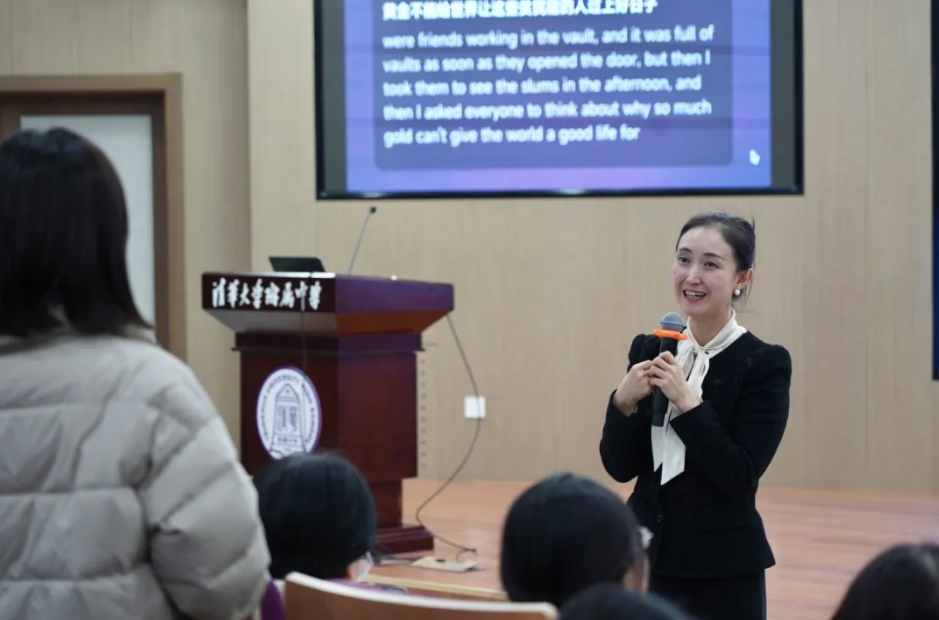
The lecture featured Professor Teng Jun, Associate Dean of the Faculty of Education at Beijing Normal University, Professor and PhD supervisor at the Institute of International and Comparative Education. She is not only a scholar with years of expertise in international education research but also a "Haidian Mom."
Without a single slide, Professor Teng engaged in a natural and deep dialogue with parents. Starting from their genuine concerns, she delved into the essence of international versus domestic education, the meaning of studying abroad, future educational trends, and how to nurture a child "who can navigate the world freely."
Breaking the Dichotomy Between "International" and "Domestic"
"We often pit international education against traditional education as opposites, but at their core, they share the same 'root'—both are education," Professor Teng began, addressing a common parental misconception.
Tracing the development of international education in China—from the 1990s mindset of "studying abroad if you can't get into a good domestic university" to today's more rational considerations of "why go abroad" and "what to learn there"—she emphasized that whether in an international or domestic system, whether following AP curricula or the Gaokao, the essence of education remains the same: to cultivate a healthy, well-rounded individual capable of finding their place in the world.
"Instead of wrestling with whether to choose an international or domestic path, it's better to first ask: What kind of education do you want? What kind of person do you hope your child becomes?", proposed Professor Teng.
Studying Abroad: Not a "Calculation," but a "Life Experience"
A father candidly asked, "Should I send my child abroad? My thinking is simple: I hope they can obtain a better diploma."
Rather than giving a direct "yes" or "no," Professor Teng probed further: "Amidst the ongoing changes in domestic and international landscapes, has your consideration of this matter shifted? Factors like safety, economics, or national development?"
She guided parents to move beyond the traditional "calculation logic"—focusing solely on economic cost and return on investment—and to consider the "incalculable value" of studying abroad: cross-cultural experience, broadening horizons, cultural diversity and self-awareness.
"Studying abroad may not bring direct 'economic returns,' but it enriches one's life experience. Only by witnessing the diversity of the world can one develop a stable and mature worldview.", explained Professor Teng.
A High School Student’s Question: If Studying Abroad Isn’t About “Gilding,” Then What Is It For?
During the lecture, a student’s question shifted the focus of the discussion from "parental anxieties" back to "the students’ own growth." "Will studying abroad truly bring me spiritual and psychological growth?" she asked, getting straight to the heart of the matter. Her next words captured the genuine sentiment of today’s younger generation: "I simply want to go out and see the world, to improve myself for my major or my interests." She then pressed further, asking whether, for the sake of self-improvement, one should prioritize academic learning or immerse oneself in the local culture and history.
This student’s question precisely highlighted the central tension in current reflections on studying abroad: now that the notion of "gilding" has faded, what exactly are we seeking by pursuing education overseas? Professor Teng did not offer a definitive answer. Instead, she first affirmed the student’s desire to "see the world"—explaining that it ultimately relates to whether one can develop a "stable and mature worldview." At the same time, Professor Teng also broadened the pathways to achieving this goal: obtaining a degree and enriching one’s inner self do not necessarily have to be accomplished simultaneously during a single study abroad experience. In fact, physical presence abroad is not even a prerequisite. Through extensive reading and proactive exploration, one can achieve "localized internationalization" right where they are and broaden their horizons. This student’s question clearly reflects how the younger generation has moved beyond mere "economic calculations," prioritizing instead inner growth and a more holistic life experience.
The Ultimate Goal of Education: Cultivating Individuals Who Can "Navigate the World Freely"
"Why is broadening horizons important? Is it not possible without it?" Professor Teng turned the question back to the parents.
One parent responded, "With broader horizons, children can learn to manage themselves and handle uncertainty earlier."
Professor Teng agreed deeply and elaborated: "The essence of education is to teach a person how to find their footing in this world. An individual with broad horizons and one who is closed-off will inevitably navigate the world in different ways and with different capabilities."
She noted that future society needs not "test-taking machines," but individuals who can adapt to diverse environments, possess cross-cultural understanding, and make sound judgments in complex situations. "This is what we often call 'global competence'—the ability to face the world with a stable, mature value system."
THIS Parent School: Building an Educational Community, Empowering Growth
The lecture was warmly received and highly praised by the attending parents. Professor Teng frequently walked among the audience, and parents' enthusiasm for asking questions lasted until the very end. One mother remarked after the event, "The greatest takeaway today wasn't finding a specific answer, but learning how to think about educational issues."
In her concluding remarks, THIS Executive Principal Ms. Zhu Ying stated, "The significance of the Parent School lies in bringing educators and families together to face real issues and explore the essence of education. Professor Teng's sharing combined scholarly depth with a mother's warmth—exactly the kind of 'grounded wisdom' we hoped for."
There is no one-size-fits-all answer in education, but good education always begins with dialogue, grows through consensus, and culminates in action. The THIS Parent School is not merely a platform for knowledge transfer; it is committed to building a growth community where educational insights are shared and wisdom is collectively nurtured.
As Professor Teng said, "The process of raising children is also parents’ second growth. May we all become that unwavering light in our children's world, illuminating the path ahead while warming the journey home."