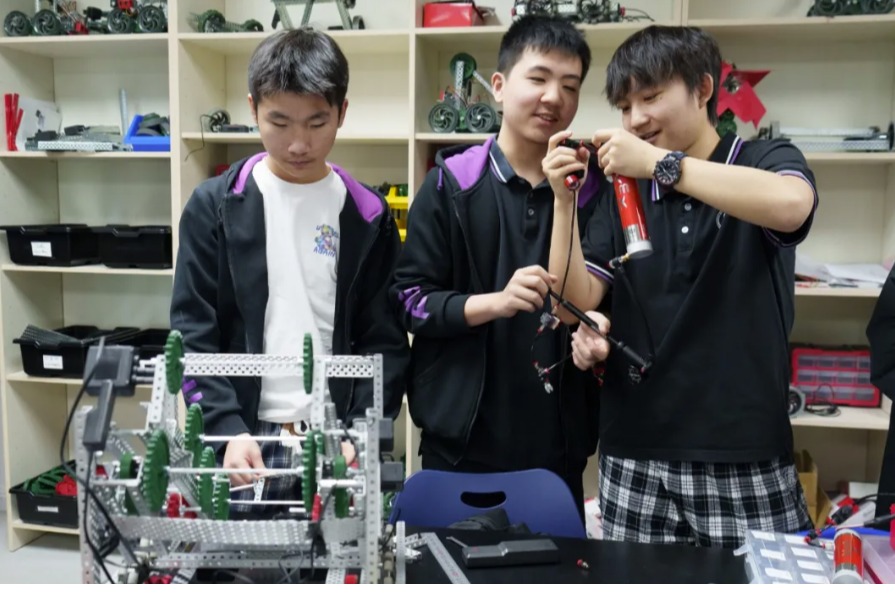
Students from Tsinghua International School (THIS) Robotics Team were busy fine-tuning their robots after school on Tuesday, January 13, 2026, during their routine activity time, to prepare for the upcoming VEX V5 Qualifiers scheduled on January 17-18, 2026.
The teammates are a bit unsure about the chances of winning and will happily accept whatever result, since it will be their first-ever competition of any kind. The team is brand new – as it was only inaugurated a few months ago.
Creation of Robotics Club
In September 2025, shortly after the school year started, Benjamin Yang, an eleventh grader (11P) and enthusiast of robotics, took the initiative to create the THIS Robotics Club, following the school's encouragement that students could start their own clubs so long they comply with the school's rules and regulations. He deemed having such a club could help him and other like-minded students deepen their enthusiasm.
Benjamin recalled joining in a UCLA summer school building rovers and said:
"I enjoyed it so much and thought why don't we have our own robotics club at THIS."
The creator naturally became the captain.
Benjamin Yang (C), Bobby Li (R) and Tony Lei (L) work to fine-tune their robot on Jan. 13, 2026.
Bobby Li (11P), the team's professional driver, the person who controls the robot at the arena, shares such an interest.
"Benjamin and I are good friends. I thought it was cool to join a club where we can build robots for competition," he said.
In the beginning, middle schoolers and high schoolers mingled together for club activities but soon after the club expanded, HS and MS students formed their own teams with different agendas, although they were both under the same umbrella of the THIS Robotics Club.
Dr. Adriana Mallary, Head of the Technology Department and HS Robotics teacher, and Mr. Paul Moon, Secondary STEAM teacher, happily serve as the club's supervisors, coaching the HS team and MS team, respectively.
Overcoming Obstacles
Having the enthusiasm for robotics is one thing but turning it into a competitive working robot is quite another.
Benjamin manifested that as the school's forerunners in robotics competition, the (HS) teammates "had no idea what to do in terms of building a robot for contest." They had to "feel their way forward and build everything from scratch."
"We didn't know what to do in the beginning. We faced problems – and we still do," said Benjamin.
"For example, last month during our practice scrimmage at another school, our first prototype robot had problems in its drive shaft. It took us two hours to fix."
Bobby echoed as saying that in the initial stage of the robot's building, they constantly had to figure out how to improve the design.
Watching the students blocked by obstacles, Dr. Mallary, has to remain patient as she cannot help them directly because according to Dr. Mallary, as per the VEX competition's rule, teacher-supervisors are not allowed to intervene with the robots' designs.
"As a coach, I can guide and support students, but the robot itself must be designed and built by the students. These VEX rules ensure that the design and build reflect student learning," she said, explaining how students are encouraged to solve problems independently while not left unsupported.
Although teachers sometimes would have to resist their temptation to intervene and help, for Dr. Mallary, "it is also a learning experience" since it is also her first-ever robotics competition. She added that providing general guidance to students was allowed and that is what coaches are for.
Preliminary Achievement
Within one semester, the team has managed to build a decent contest-going, VEX-standard robot that roves around in the arena, picks up and holds the plastic ball before launching it into the goal to score – while trying to stop competitors' robots from doing so.
To date, the students have tested their robot, put it in simulated competition, and know in which direction further improvements are necessary. In the earlier-mentioned scrimmage last month, their robot scored one goal – best performance in that day and on par with another, well-experienced team.
"That quite exceeded our expectations," said Benjamin.
For the upcoming match, their expectation is simple: testing their robot and ideally, scoring at least one goal.
For everyone on the team, this is the change from zero to one. Based on that, they could make continuous, uncapped progress.
Practicing Core Values
From Dr. Mallary's perspective, the Robotics Club provides an excellent opportunity for students to explore hands-on engineering, coding and problem-solving skills in a real-world context, whether they are trying something new or looking to extend existing interests.
The Robotics Club is also a place where students practice THIS Core Values, especially Innovation and Collaboration.
Designing a complex robot has been an innovative job for the students. Benjamin explained that although there were existing examples they could refer to, every single detail required their own decision.
"The robot's wheel structure, power transmission, motor design and motor placement …The whole thing has been our innovation!"
he said, explaining that Coach Mallary at most provided guidance and suggestions, which they once even rejected.
According to Mr. Moon, in VEX competitions, students can make innovative changes and improvements to VEX prototype design the way they see fit, so long as students are using VEX components and parts.
For a new team that has come this far, collaboration has certainly played its role. Bobby shared that during the construction of the robot, every step – including backward changes – should be recorded for VEX tournament inspection.
"While building is the main job, recording is equally important and it takes a lot of coordination as the builders need to tell the recorder what has been changed," said Bobby.
According to them, their friendship has strengthened in the time after entering the Robotics Club.
"The strengthening is of positive relevance to your contribution to the team," Bobby noted.
Support from School
This school year, the school purchased one VEX competition kit as well as the official field / arena kit, to support students pursuing their Robotics interests. The school has also supported the team by providing the essential materials needed to get started and supporting field trip opportunities to practice with other international schools.
Looking ahead, according to Dr. Mallary, the school is mulling over creating a larger dedicated space where the full competition arena can be set up for realistic testing and iteration.
Growth Beyond Club
While Robotics, Computer Science and STEAM, among other courses offered at THIS, apparently give a boost to the students for their Robotic Club activities. Reversely, their experience also benefited their academic performance.
According to Mr. Moon, students who participated in Robotics Club activities are more prone to exhibit excellence back in their classes and become the course leaders. He said that it is not only because they have experienced more robotic devices elsewhere, but also that they have internalized the knowledge.
"In class, when they design and build other things, they have to consider coding, mechanics, force, center of mass. All these things are related to math, science, STEAM and other courses and projects in class where they are required,"
he said, explaining how Robotics Club experience would transfer to students' classroom performance.
For both Benjamin and Bobby, who will be applying for university in about one year's time, their experience in the Robotics Club will certainly give a boost to their college applications.
"VEX is a globally recognized event. It will certainly help, and more so if our robot could get a fine performance in the upcoming tournament," they both said.