A child gently closes the bedroom door, while a thousand questions swirl in their parent's mind. Why won't they say more? Why has my concern become a source of pressure? I want to draw closer, but I am afraid of intruding. I want to let go but find it hard to bear the distance. During adolescence, the relationship between parents and children can leave both sides feeling lost, caught between parental love and the need for personal space.
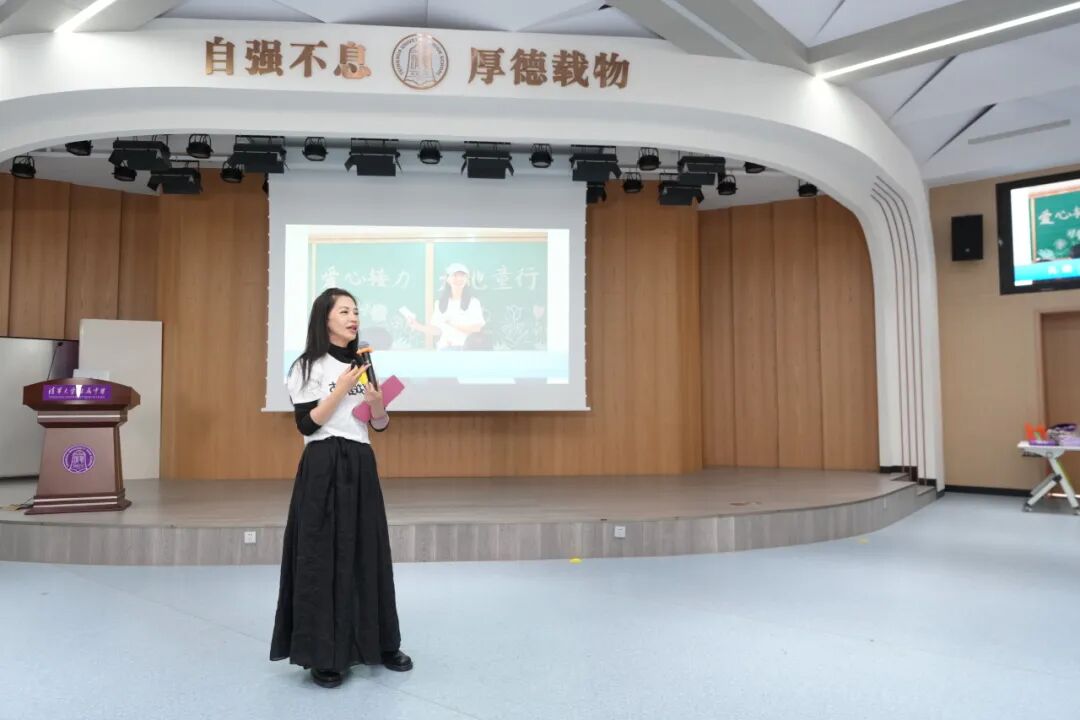
Tsinghua International School (THIS) hosted on Oct. 27, 2026 a drama-based psychology workshop, in partnership with the Parent Council's Mental Health Club. During the Parent School's workshop, Kong Wei, a THIS parent and renowned actress with a master's degree in psychology and a commitment to public service, guided parents into the world of drama.
Through body-based exercises, family relationship sculpting, drawing and meditation, participants were invited to set aside judgment and see their children anew, while recognizing that they, too, needed understanding.
The Tsinghua University Center for Film and Television Communication provided the academic framework for the event. Song Jingjing, Vice President of THIS Parent Council and a member of the Tsinghua University Center for Film and Television Communication, and Kong Wei, the presenter, jointly organized the event.
See First, Then Draw Closer
Using theatrical art to explore growth issues and parent-child relationships, Kong did not offer parents a list of communication techniques.
"This class does not teach parenting methods or how to negotiate with children," she said. Instead, she invited participants to put aside analysis and judgment temporarily, using their bodies to feel and their eyes to observe in a safe, inclusive group setting.
During one exercise, parents moved freely around the room. When they encountered one another, they exchanged names and added a simple phrase: "I'm here."
Kong recalled that during a low point in her life, a close friend would end every phone call by saying, "It's OK. I'm here." Those simple words gave her strength when she needed it most. She hoped to become that kind of reassuring presence for her own child, someone always willing to say, "I'm here."
In a "family sculpture" exercise, three parents took on the roles of parent, child and "expectations." Representing academic performance and hopes for a bright future, the person playing Expectations stood behind the parent. The child, meanwhile, was free to move closer, step back or even refuse to engage.
Kong encouraged the group to recognize that having expectations is not inherently wrong. But when expectations press closely against parents, who in turn keep moving toward their children, care can become a source of pressure.
Kong encouraged the group to recognize that having expectations is not inherently wrong. But when expectations press closely against parents, who in turn keep moving toward their children, care can become a source of pressure.
Accept Children, and Our Imperfect Selves
During the drawing exercise, parents used pictures, symbols or words to portray family relationships as they saw them, then shared their work in small groups. There were no right answers and no judgment. Listening to one another helped parents realize that every family faces its own challenges and every parent is still finding their own way.
During meditation, Kong invited parents to imagine the familiar scenes of family life: a child's lowered face at the breakfast table in the morning, or the bedroom door quietly closing as they head straight to their room after school. Beneath a child's outward show of strength may lie academic pressure, comparisons with peers and self-doubt.
The focus then shifted to parents themselves. Worries about grades and the future can make parents anxious, impatient and prone to pushing too hard. After speaking too harshly, they may be left alone with their regret.
Kong reminded the group that anxiety does not mean a lack of love. Impatience often grows out of deep concern. Parents, too, are navigating adolescence with their children for the first time. There is no script and no rehearsal. They can change their behavior, but they can also allow themselves to be less than perfectly composed.
I allow you to grow up at your own pace, and I allow myself to learn at my own pace.
This guiding phrase gave voice to feelings that many parents find difficult to express. Accepting children does not mean giving up on them. It means no longer insisting that they fit a parent's expectations of what it means to be "obedient" or "mature." Accepting oneself means recognizing that parenting is a process of learning along the way, without dismissing one's efforts after a single argument.
During the discussion that followed, one parent shared that when their child feels anxious, they first sit down and listen before offering advice gently. Another parent reflected that in the past, they had not always given their daughter their full attention or responded thoughtfully enough. She resolved to listen more attentively and offer more specific, considered responses starting that day.
Recalibrate Expectations
Renee Zhu, THIS Executive Principal, drew on her own parenting experience to reflect on academic performance, happiness and parental expectations.
"For many parents, expectations for their children gradually shift downward over time," Zhu said.
She reminded the group that expectations are easily influenced by external factors. Drawing on more than two decades of experience in education and her own child's growth, she invited parents to consider a fundamental question:
When it comes to children, what matters more: academic achievement or happiness?"
Parents need to keep recalibrating their expectations, giving children room to explore, make adjustments and take a greater role in planning their own futures. Education is not about walking a predetermined path on a child's behalf. It is about accompanying them as they gradually discover their direction and build the confidence to face difficulties along the way.
Toni Dong, Vice Principal of Operations, noted that the workshop differed from a conventional lecture because it emphasized personal experience. "Today, it was much more about feeling," she said.
Also present at the Parent School workshop was Weiky Liu, THIS Vice Principal and Head of Secondary.
Make Wellbeing Part of Daily Growth
Wellbeing ranks first among THIS' six Core Values. The school looks beyond students' academic performance to consider whether they can care for themselves, connect with their peers, develop resilience under pressure and draw strength from relationships with others.
As Bernard Geoxavier, Associate Head of Secondary at THIS, shared in a recent article that
Wellbeing is about finding balance. While managing academic pressure, students also need time to look after themselves and connect with their community, sharing kindness and smiles with those around them. Support from others can help students build inner strength and develop greater resilience when facing challenges and setbacks.
At THIS, wellbeing is not simply an aspiration expressed in words. It must be reflected in curriculum design and everyday campus life. When revising the Secondary timetable, the school developed a yearlong course with eight themes, including social and emotional wellbeing, academic growth, and the sharing of achievements and recognition. A 45-minute session is scheduled each week to help students rebuild their sense of belonging and connection within the school community.
These opportunities for growth also extend beyond the classroom. Students can enjoy the sunshine and spend time in nature. They can team up with peers from different grade levels to take on challenges, discovering through collaboration what it means to rely on and support one another. They can also take a quiet moment to write a letter to their future selves, ready to revisit it when they need encouragement.
Through concrete, sustained experiences, the school hopes to help students understand themselves, empathize with others, seek support and discover their place within a community.
From helping students navigate emotions and relationships to encouraging them to participate in group activities, explore their interests and face challenges, THIS strives to provide more than room for academic achievement. It seeks to give students a journey of growth in which they develop physical and emotional wellbeing, become increasingly independent and learn to take responsibility.
Children do not grow according to a fixed script, and parents do not have to get everything right. Adolescence is a gentle process of growth in both directions: Children learn to become independent, while parents learn to let go and rediscover what love and companionship mean.
May every family find a comfortable balance between closeness and distance, allowing its children to grow with confidence and security while its parents continue learning how to love with understanding and gentleness.