Tsinghua International School (THIS) welcomed on Oct. 19, 2026, 14 educators from South Africa, Botswana, Kenya and Indonesia for a closer look at how the school combines international educational approaches with a strong Chinese identity. Through classroom observations, a campus tour and discussions with school leaders, the visitors learned how a supportive learning environment can foster academic achievement, independent thinking and well-rounded development.
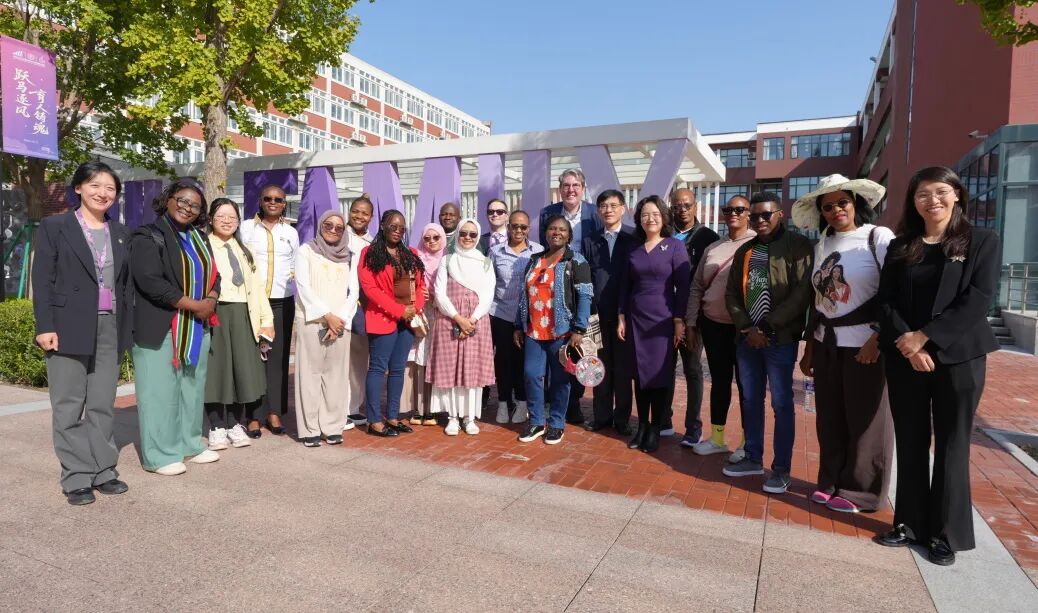
The visit was part of the Seminar of Comprehensive Measures for Rural School Teachers from Developing Countries, organized by East China Normal University under the commission of China's Ministry of Commerce. The program brings together education officials and teachers to learn about China’s educational practices through lectures, field visits and cultural activities.
At THIS, the delegation observed both primary and secondary classes before meeting with the school’s administration team, led by Executive Principal Renee Zhu. The seminar was moderated by Vice Principal of Operations Toni Dong.
Int'l Education with Chinese Roots
During the discussion, Principal Zhu introduced the history of Tsinghua University High School (THUHS), to which THIS is affiliated, and explained the school's close relationship with Tsinghua University. THIS was founded in 2009 in part to accommodate the children of overseas Chinese scholars returning to teach and conduct research at Tsinghua University and other institutions.
Today, the school offers an educational experience that combines Western educational philosophies and practices with international academic standards and Chinese language and culture.
"Tsinghua International School fosters creative critical thinkers who have roots in China and are prepared to lead in the global community," the school's mission states.
Principal Zhu also outlined THIS' six Core Values: Wellbeing, Respect, Collaboration, Integrity, Innovation and Leadership. These principles guide students' learning and development while shaping the school’s approach to supporting its teachers.
By making teacher wellbeing an essential part of school culture, THIS seeks to create the conditions for effective teaching and meaningful learning.
Academic Principal Scott Pare then explained the school's curriculum, which draws on Western educational frameworks and emphasizes inquiry-based learning, critical thinking and active student participation.
Students are encouraged to ask questions, explore concepts and explain their reasoning rather than simply memorize information.
Chinese language, Chinese History and Eastern Art are also distinctive elements of the curriculum. Students devote substantial instructional time to Chinese language learning and explore Chinese culture through drama, student-produced newspaper posters, art projects and curriculum-linked trips to historical and cultural sites.
For Principal Pare, this commitment to Chinese culture is central to the school's identity. An international education, he explained, "should not require students to leave their cultural roots behind; instead, students can develop the skills to participate in a global community while gaining a deeper understanding of China."
The delegation also learned about opportunities that connect students with a wider academic community, including interactions with experts, research-oriented programs and international exchanges. Together, these experiences help students explore their interests and develop the confidence to apply their learning beyond the classroom.
A Classroom Where Students Think for Themselves
For several visiting educators, classroom observations were among the most memorable parts of the visit.
Desiana Mithayani, a primary school teacherfrom Indonesia with a particular interest in STEAM, was especially impressed bya Grade 5 mathematics lesson. Through puzzles and other engaging activities,the teacher made the challenging concept of fractions more accessible tostudents.
What stood out was not simply the teaching technique, but the way students approached learning. They participated confidently, explained their reasoning and worked to understand the concepts behind the answers.
Desiana Mithayani said the experience gave her a valuable opportunity to look beyond academic performance and see how teaching practices can encourage independent thinking. She hopes to introduce more creative mathematics activities and hands-on STEAM projects using locally available materials when she returns to Indonesia, as well as share these ideas with fellow teachers.
For her, the goal is not to replicate another education system wholesale, but to learn from effective practices and adapt them to the needs of her own students.
Other delegates similarly noted the balance between academic expectations and students' wider development.
Lesego Matseke, a senior teacher from Botswana, said the school exceeded her expectations. Although she had anticipated a strong focus on academics at an international school, she was particularly struck by the attention given to sports and extracurricular activities alongside classroom learning.
The students themselves also made a strong impression. Delegates observed that students had opportunities to excel in different areas, combining academic learning with talents such as playing basketball, performing in the school band, and taking leadership roles in student organizations.
Such versatility reflects an approach to education that recognizes students as individuals with different abilities, interests and aspirations.
A Culture of Wellbeing, Respect and Collaboration
The school's emphasis on relationships and wellbeing also resonated with the visiting educators.
Anne Kirigo Ndiritu, an administrator with Kenya's Ministry of Education, praised the school's well-organized learning environment and its commitment to innovation, critical thinking and active student participation. She saw potential for adapting elements of THIS's holistic educational approach to Kenya's competency-based education curriculum.
Several delegates were very interested in the attention given to teacher wellbeing.
Ntombela Xoliswa, a lecturer and Ph.D candidate at Tshwane University of Technology in South Africa, praised THIS's welcoming environment, students' respectful conduct and commitment to holistic education. She was particularly impressed by the school's support for students facing learning challenges and its attention to everyone's wellbeing, saying these practices could offer valuable lessons for schools in South Africa.
Ni'mah Faadlilah, echoed as saying that educators who feel valued and supported are better positioned to create a positive classroom environment.
This philosophy is reflected in the school's six Core Values, which extend beyond statements on a wall to inform daily teaching and school life. Through collaboration, student leadership and personal guidance, THIS aims to cultivate a community in which academic growth goes hand in hand with character development.
THIS Vice Principal and Head of Secondary Weiky Liu and Head of Primary Sean Simkins, also discussed how these values are practiced across grade levels. While the approaches differ between primary and secondary education, the shared goal is to help students develop the skills to work with others, take responsibility and apply their learning in meaningful ways.
For educators working in other developing countries, some of these practices offered useful lessons. Delegates from Botswana, for example, reflected on how global competence can be developed without sacrificing local languages and cultural identity. They also noted that effective teaching does not always depend on sophisticated equipment; thoughtful instruction, strong teacher-student relationships and the creative use of available resources can make a meaningful difference.
Learning Across Borders
For THIS, the visit provided an opportunity to share its educational practices while engaging with educators whose experiences reflect different national and local contexts.
The delegation's questions and observations also highlighted that educational exchange is most valuable when it goes beyond a simple comparison of school systems. By examining how teaching methods, school leadership and cultural identity interact in practice, educators can identify ideas that may be adapted to their own communities.
As these visitors return to their schools and institutions, the lessons they take from THIS may reach classrooms far beyond Beijing. A puzzle that helps a student understand fractions, a school culture that values teacher wellbeing, or an approach that brings local heritage into an international education can each inspire new possibilities in a different setting.
At THIS, international education is not simply about preparing students to study or work overseas. It is about equipping them with the knowledge, critical thinking skills and cultural understanding to engage confidently with the world, while remaining grounded in China.
The visit offered a glimpse of how that vision takes shape in everyday school life: in the questions students ask, the ideas they explore, the relationships they build and the many ways they learn to make a difference.