On November 29, Tsinghua International School (THIS) and Saïd Business School, University of Oxford jointly hosted an exceptional academic event, welcoming Professor Myles Allen, a leading climate scientist from the University of Oxford and a key physicist behind the net-zero concept. The session, centered on "Climate Change and a Net-Zero Future," featured insightful speeches and vibrant interactions, highlighting our students' critical thinking and global perspective.

This event was moderated by Paul Lin, Co-Chair of the Competition, Vice-President of Oxford & Cambridge Alumni Society Shanghai, and Oxford alumnus. At the event, THIS students showcased their sharp critical thinking and global perspective, engaging actively with thought-provoking questions and demonstrating exceptional intellectual curiosity throughout the session.
THIS Executive Principal's Opening:A Call to Action for the Next Generation
The event opened with remarks from Ms. Zhu Ying, Executive Principal of THIS. She warmly welcomed Professor Myles Allen, hailing his academic contributions: "As a leading authority at Oxford, Professor Allen's research has reshaped our understanding of the climate crisis, and his advocacy for 'Net Zero' has become a rallying cry across generations."
Principal Zhu emphasized that the climate crisis is a defining challenge for today's youth. For educators, it’s an opportunity to connect teaching with cutting-edge science; for parents, a window into how daily choices shape the future; and for students, a precious chance to engage directly with top scientists and link personal growth to global responsibility.
Professor Allen: The Science of Warming and the Path to Net Zero
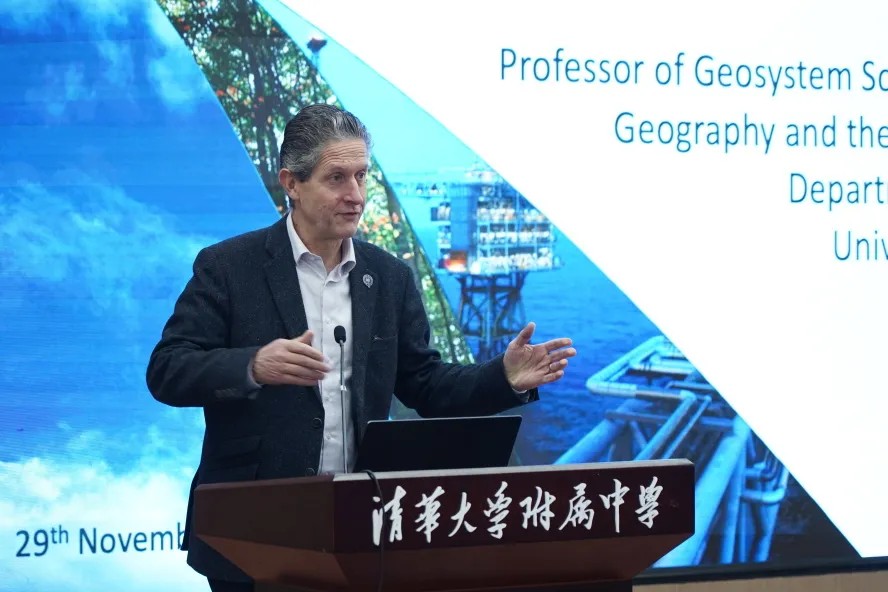
Professor Allen then traced the scientific journey of understanding global warming. He showed how predictions from 1975 align closely with actual temperature rises, explaining the core mechanism of the greenhouse effect through John Tyndall's classic experiment and atmospheric principles. "The world is warming predictably," he stated, distilling Net Zero to its essence: "Every ton of CO₂ we emit pushes temperatures up. Stopping warming means stopping the increase in atmospheric CO₂."
He addressed challenges with candor and hope: completely halting emissions is difficult, especially from industries like cement production, making carbon capture and storage vital. "We must responsibly dispose of CO₂, like we do with waste—capture it and return it underground. This is the solution needing young minds to tackle its technical and economic hurdles."
Dialogue with Professor Allen
The fireside chat, led by host Mr. Lin Zi, was a key highlight. The engaged audience—students and parents—drove the conversation with probing questions spanning climate science, technology, policy, and personal responsibility, creating a rich and enlightening dialogue.
One student inquired about the feasibility of achieving net-zero solely through emission reduction, leading Professor Allen to explain the necessity of Carbon Capture and Storage (CCS) technologies. "It's a little bit like 200 years ago, we put all the rubbish, all the sewage in the river. That was a bad idea and we stopped doing it," he analogized. "We need to think about disposing of CO₂ responsibly, not just using the atmosphere as a free dump." He specifically encouraged young learners to tackle this challenge: "I'm hoping some of the young people in this room will make their life mission... to work out how to capture and dispose of carbon dioxide."
Another student probed the potential of using CO₂ as an energy source. Professor Allen clarified the fundamental distinction between energy storage and generation, praising the student's line of thinking while explaining the thermodynamic limitations of CO₂ as a low-energy molecule.
The host, Mr. Lin, also raised an education-related question: "Climate change is a multidisciplinary issue, yet school subjects are often taught in isolation. What advice do you have for schools on integrating curricula and developing climate education?"
Professor Allen shared insights based on Oxford's experience: "A strong foundation in core subjects is essential, but we must also encourage students to think across disciplines. For example, connect mathematics to global temperature trends, use physics to explain the greenhouse effect, and apply economic thinking to analyze climate policies. At Oxford, we developed the 'Maths for Planet Earth' project, which reframes traditional math problems around climate-related scenarios — helping students see how subject knowledge links to real-world challenges."
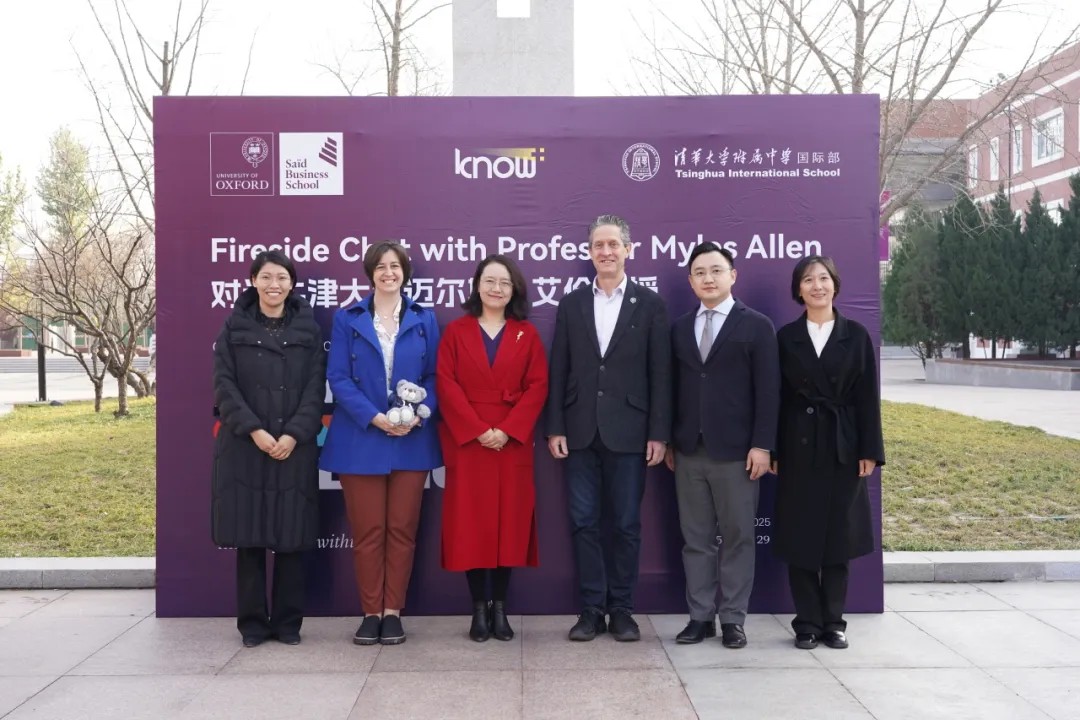
Afterwards, students gathered around Professor Allen, continuing the discussion. This dialogue bridged academia and action, the personal and the global. It deepened the THIS community's scientific understanding and ignited a passion for action.
At the recent "G20 Education Dialogue and International Symposium on Education and Sustainable Development" hosted by THIS, our students presented their ongoing projects, extending their understanding of climate issues into real-world contexts.
One team designed an initiative inspired by the "butterfly effect" to educate peers about the importance of protecting non-renewable energy sources. Sustainability Club launched a "Carbon Footprint Project" to track and reflect on paper consumption on campus. A further group produces a weekly podcast to consistently promote sustainable living practices. These explorations, centered on the UN Sustainable Development Goals and G20-related themes, are not only an exercise in academic skill but also vivid proof of a younger generation taking proactive climate responsibility and engaging in global environmental governance through action.
Tsinghua International School remains committed to providing platforms for such high-level dialogues, guiding students to learn and grow through real-world challenges, and nurturing future leaders with Chinese roots and global competence.